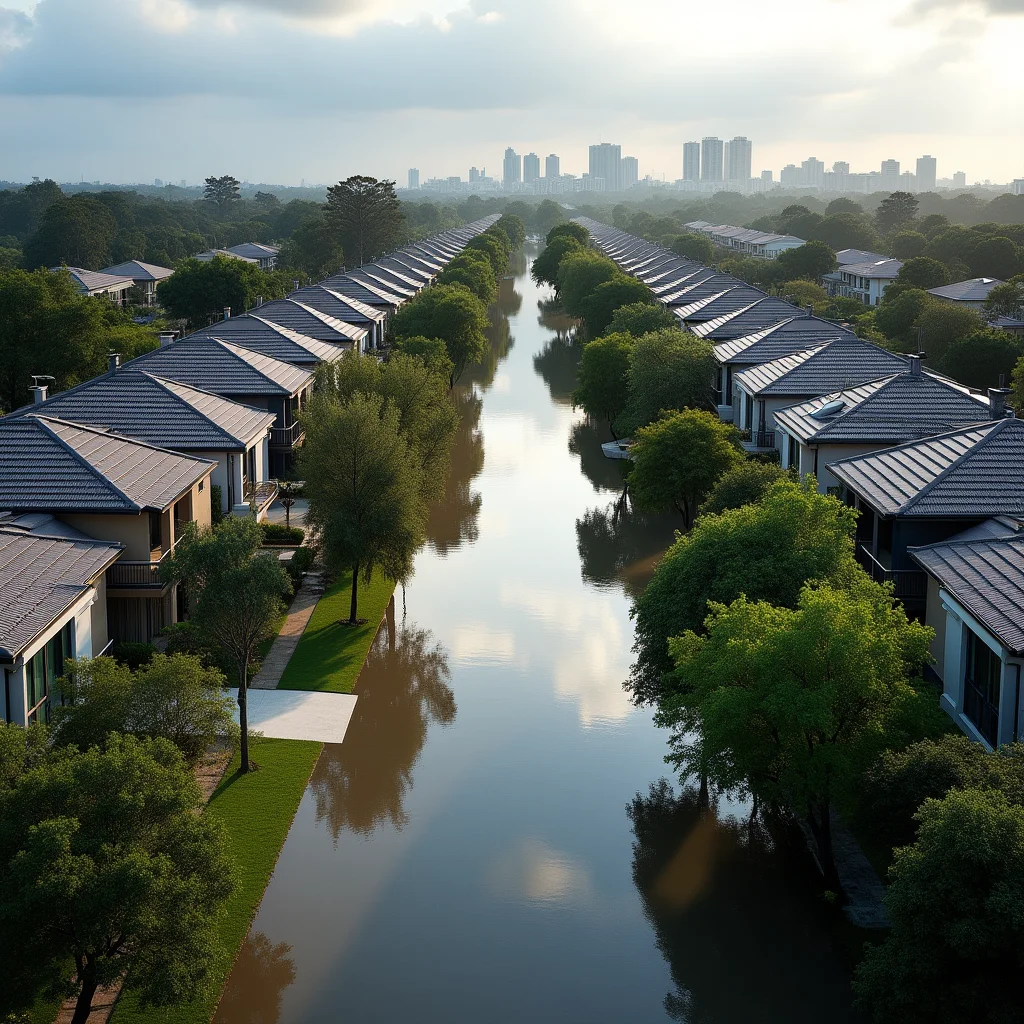
According to realestate.com.au, one hand-built home in Honeywood took its owner approximately three decades to complete, beginning in the mid-1990s. The result is a deeply personal and financially significant project — one with bespoke finishes and non-standard construction methods that sit well outside the parameters of a typical volume-built home. That story is an illustration of a broader problem affecting ordinary Australian homeowners: building insurance sums-insured that no longer reflect the actual cost of rebuilding a property from the ground up. After years of elevated construction costs, many policies written even a few years ago now fall well short of what it would cost to reconstruct the same home today.
What Is a Building Sum-Insured and How Is It Calculated?
A building sum-insured is the maximum dollar amount an insurer will pay to rebuild your home if it is totally destroyed. It is not the market value of your property — the land component is excluded — and it is not the purchase price you paid. It is strictly the cost of reconstructing the dwelling, including foundations, walls, roof, fixtures, and fittings, to the same standard as before the loss. Most standard home building policies in Australia are written on an agreed or specified sum-insured basis, meaning the owner — not the insurer — carries the primary responsibility for nominating an adequate figure at the time of policy inception and at each renewal.
The calculation depends on a number of inputs: the size of the home in square metres, the construction materials (brick veneer, double brick, timber, steel frame), the quality of internal finishes, site conditions such as slope and accessibility, and any specialist features like a swimming pool, outbuildings, or solar installations. Most insurers offer online sum-insured calculators that generate an estimate from these inputs, but those estimates are only as accurate as the data entered. Owners who underestimate floor area, misclassify their construction type, or omit a granny flat from their calculation can end up substantially underinsured from day one.
For buyers of recently constructed or custom-built homes, the practical starting point is to obtain a professional building valuation for insurance purposes — not a property market appraisal — from a qualified quantity surveyor. This is especially relevant for homes with unusual finishes, architecturally designed features, or heritage elements that standard calculators struggle to price accurately. The cost of a professional valuation is modest relative to the coverage it validates.
It is worth distinguishing the sum-insured approach from "total replacement" policies, which some insurers offer and which commit to rebuilding the home to its original standard regardless of cost. Total replacement cover removes the underinsurance risk entirely but tends to carry a higher premium. Not all insurers offer it, and eligibility conditions typically apply. For most Australian homeowners on standard building policies, getting the sum-insured right remains their own responsibility.
How Construction Cost Inflation Opens the Underinsurance Gap
Construction costs across Australia rose sharply in the years following 2020. While the pace of increase has moderated more recently, the cumulative effect means that homes insured several years ago at what was then an adequate sum-insured may now be significantly undervalued. A building policy that has not been reviewed in recent years is likely carrying a gap between the nominated sum-insured and the current cost of reconstruction.
The mechanism is straightforward. If your home would cost a certain amount to rebuild when you first took out your policy, and construction costs have risen materially since then, the same sum-insured no longer covers the same rebuild. Most insurers apply an annual indexation adjustment at renewal — typically linked to a construction cost index — but this automatic adjustment may not fully capture local or material-specific price movements, nor does it correct for an under-specified sum-insured at inception. A policy that was underinsured when it was first written and has been indexed from that flawed base is still underinsured.
The consequences of underinsurance become real only at claim time, and typically under what the insurance industry calls a "co-insurance" or "average" clause. Under this provision, if your home is only insured for, say, 70 per cent of its actual rebuild cost, the insurer may only pay 70 per cent of any claim — including partial loss claims, not just total destruction events. A kitchen fire that causes damage costing well below your sum-insured could still result in a shortfall payout if the policy is found to be underinsured relative to the full rebuild value.
The underinsurance gap rarely shows up until a claim is lodged. By then, the shortfall between the sum-insured and the actual rebuild cost can represent a serious financial shock that arrives at the worst possible moment. Annual policy reviews tied to current construction cost benchmarks are the most direct protection against this risk.
Background: Insurance, Ownership Structure, and the Mortgage Connection
Understanding building insurance obligations also depends on how a property is held and financed. For properties under a standard Torrens title — the most common form of individual freehold ownership in Australia — the owner is fully responsible for arranging and maintaining building cover. See our guide on Strata Title vs Torrens Title Explained for a full breakdown of how ownership structure affects insurance obligations, since strata-titled properties operate under fundamentally different arrangements where the body corporate holds the building insurance on behalf of all lot owners.
For property owners with a mortgage, lenders typically require adequate building insurance as a condition of the loan — and the lender's interest is noted on the policy. However, lenders do not validate the adequacy of your sum-insured; they confirm only that a policy exists. The borrower remains solely responsible for ensuring the nominated amount reflects the true rebuild cost. There can be a temptation to minimise insurance costs by under-specifying cover. This is a false economy. For context on how your mortgage rate affects overall holding costs, the Fixed vs Variable Rate Mortgage Australia 2026 guide breaks down the trade-offs in the current rate environment. For broader macro context on property market conditions,
This article was produced with AI assistance and reviewed for accuracy. Content is for informational purposes only and does not constitute financial or property investment advice.