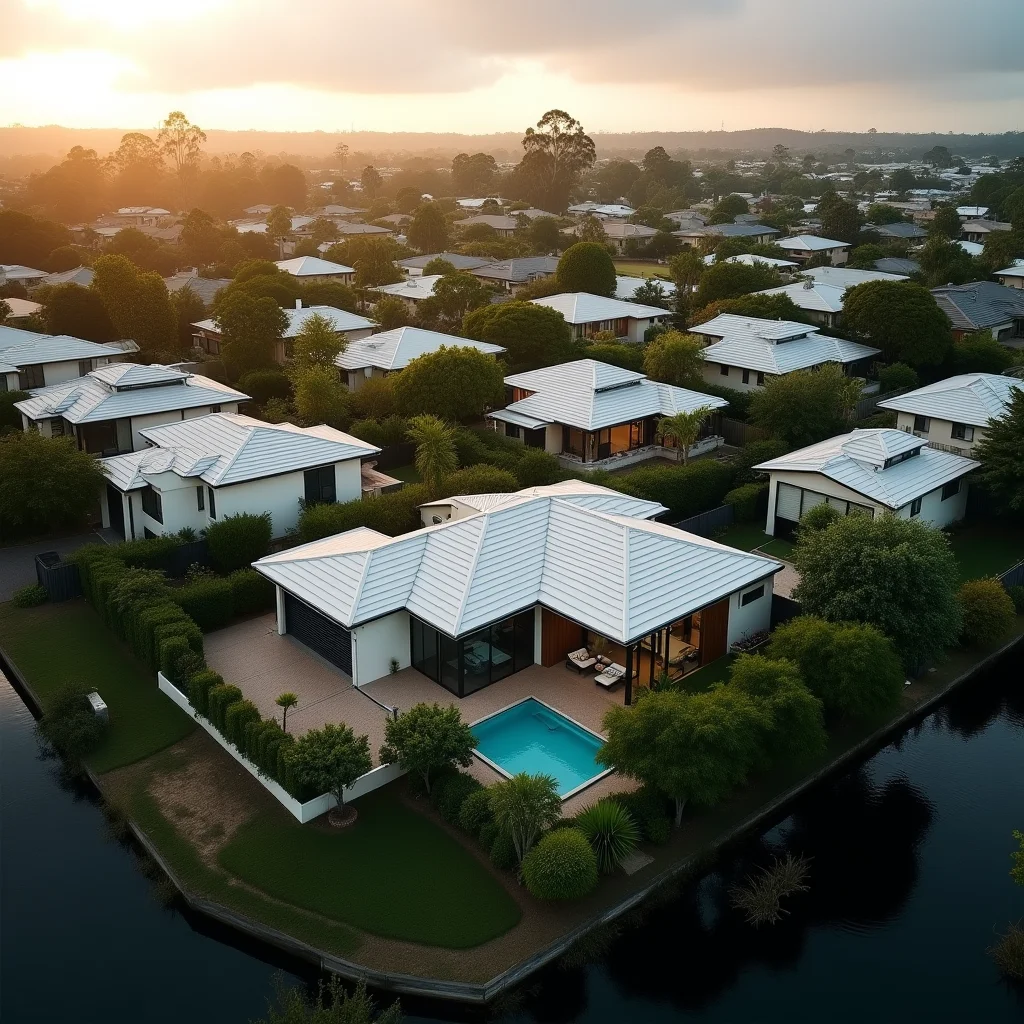
According to realestate.com.au, a Rocklea home explicitly marketed as "floodproof" — built on stilts and situated in one of Brisbane's most flood-exposed corridors — sparked a competitive bidding war involving four buyers and sold within eight days of listing, a result that cuts against the narrative that flood-affected suburbs in Brisbane's south-west are demand dead zones. The speed and intensity of the sale signals that buyer appetite for flood-resilient design is real, active, and willing to pay.
What the Rocklea Sale Reveals About Brisbane's Flood-Risk Premium
Rocklea sits within one of Brisbane's most flood-exposed corridors, inundated repeatedly during the 2011 and 2022 flood events. The fact that this property was marketed specifically for its flood-resilient design, sold in eight days with four competing buyers, tells a clear story: the market is beginning to differentiate sharply between flood-vulnerable stock and flood-adapted stock within the same suburb. This is not a generalised lift in Rocklea — it is a premium specifically attached to resilient design, elevated construction, and demonstrable flood mitigation.
For additional market context, see WealthWatchPro investment market analysis.
That distinction matters enormously for investors. A flood-adapted home in a risk-prone suburb can attract insurance at lower premiums, retain tenants through extreme weather events, and hold its value during a post-flood market downturn when nearby unrenovated homes are discounted. The market is, in effect, starting to price in climate resilience as a capital growth driver — not merely a risk management tool. Buyers who sat out Rocklea entirely after 2022 may now find themselves priced out of the very properties they considered too risky to touch.
Investor Gearing Strategy in Flood-Zone Suburbs
The Rocklea result raises a pointed question for property investors: does flood-resilient construction change the gearing calculus for historically discounted suburbs? Brisbane's south-west has long attracted negatively geared investors drawn by lower entry prices, higher gross yields relative to premium suburbs, and the tax offset available on investment losses. Understanding the distinction between negative gearing and positive gearing is central to evaluating whether flood-zone investment makes sense at any given price point.
A flood-adapted home in Rocklea, purchased at a price that still sits below comparable elevated suburbs, may generate a yield sufficient to push the investment toward positive cash flow — particularly if the land price discount persists even as the build premium is factored in. Flood-zone properties that achieve positive gearing are rare in the current environment, but the combination of discounted land, strong rental demand from tenants priced out of higher suburbs, and resilient construction creates conditions where that outcome is at least calculable. Investors should model insurance costs carefully — these can be material in flood-designated zones and will affect net yield significantly.
The National Context: Risk Pricing Is Changing Across Australian Property
Meanwhile, first-home buyers are reportedly struggling to fill the void left by retreating investors in several markets, with realestate.com.au reporting that tax reform uncertainty is denting buyer confidence nationally. In flood-zone suburbs where investor activity has historically supported demand, any further retreat by investors — combined with hesitant first-home buyers — could create genuine pricing gaps in unmodified stock. That dynamic makes the contrast with the Rocklea resilient-home result even sharper: adapted properties are attracting buyers regardless of broader sentiment headwinds.
In Brisbane's flood-affected south-west, the market is no longer treating all properties in a flood-prone suburb as equivalent risk. Buyers are differentiating with precision — and acting fast when flood-adapted stock appears. The eight-day Rocklea sale is evidence that climate resilience has moved from a design consideration to a market-pricing variable.
Practical Implications for Brisbane Buyers and Investors in 2026
For buyers considering Brisbane's flood-adjacent suburbs, the lesson from the Rocklea sale is that generic suburb-level fear is no longer a reliable guide to opportunity. Individual property due diligence on flood adaptation, construction height, insurance availability, and drainage infrastructure is now the operative framework. A flood-adapted home in a historically discounted suburb may carry less real-world risk than an older, unmodified property in a nominally safer postcode.
Investors evaluating these markets should obtain a formal flood overlay assessment and request the specific flood immunity level of any property before purchase. Insurance quotes should be obtained before exchange, not after — premium variation between adapted and unadapted properties in the same street can be substantial, directly affecting net yield calculations and borrowing serviceability assessments from lenders.
For buyers who missed the Rocklea result, the forward implication is straightforward: flood-resilient homes in Brisbane's south-west are now a recognised product category attracting motivated buyers. Supply of adapted stock remains thin relative to demand. Buyers who want to access these suburbs at value should be prepared to move quickly when suitable listings appear — the eight-day sale timeline is likely to become the norm rather than the exception for well-specified resilient homes in this corridor.
This article was produced with AI assistance and reviewed for accuracy. Content is for informational purposes only and does not constitute financial or property investment advice.