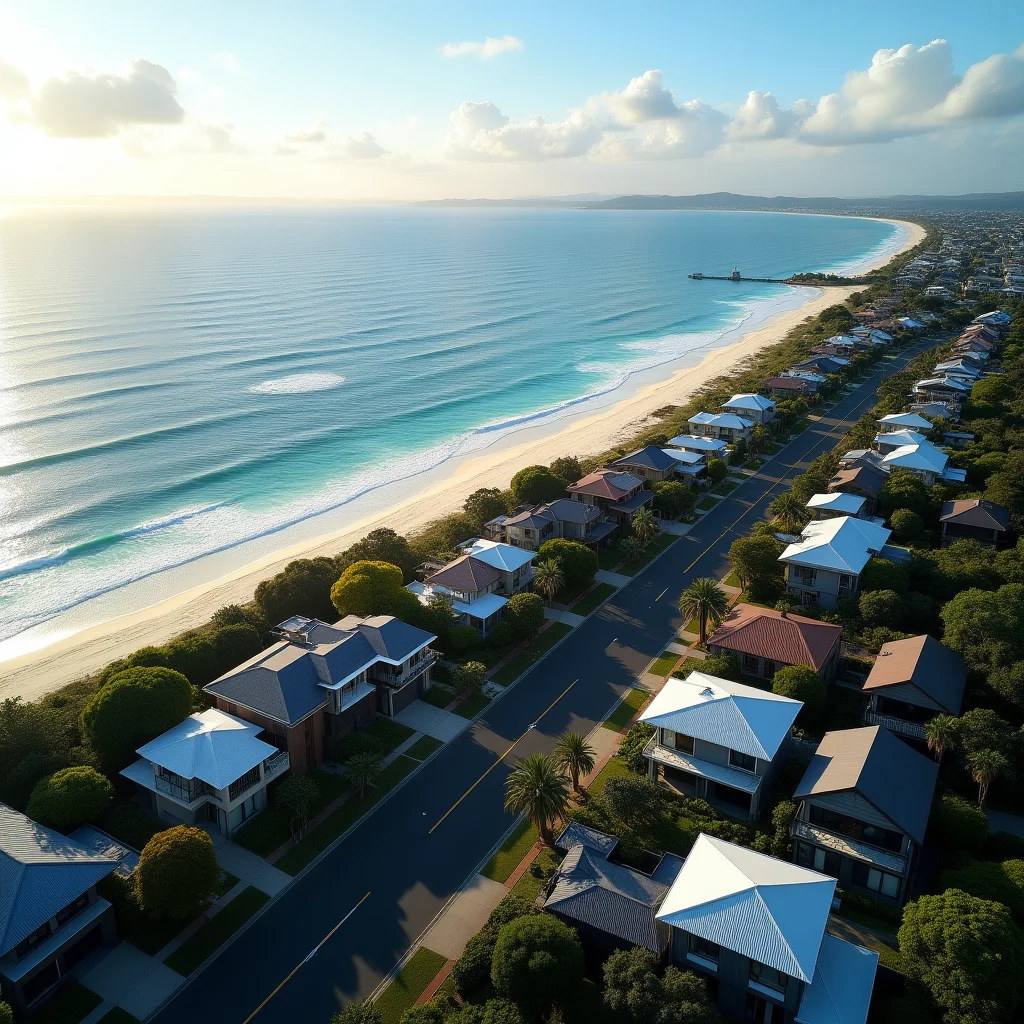
The Tax Shock Reshaping Where Investors Buy
Queensland's stamp duty liability has surged to levels that fundamentally alter the investment calculus for interstate buyers. A $180,000 uplift in transaction costs on a single purchase does not merely erode short-term cash flow — it wipes out years of projected capital gains before settlement is even reached. REAStats data shows that this cost shock has become a primary reason investors are redirecting capital away from Brisbane's inner ring, where median prices have risen sharply, toward markets where duty bills remain proportionally lower and gross yields are more attractive at entry.
The mechanism is straightforward. When transaction costs rise faster than rental income or expected growth, rational investors simply move their capital to the next tier of the market. Outer-suburban and regional Queensland markets — particularly on the Sunshine Coast — offer lower entry prices, meaning the absolute stamp duty figure is smaller even if the rate structure is similar. Meanwhile, Western Australia's lower price base and separate duty scale are producing some of the most favourable after-tax entry conditions in the country right now. For investors doing the numbers, the marginal cost of buying in Mandurah versus Brisbane's inner suburbs has never been wider.
For additional market context, see WealthWatchPro investment market analysis.
Historically, stamp duty reform cycles have lagged property price cycles by several years. Queensland's current duty settings were calibrated for a market that existed before the post-pandemic migration surge repriced South-East Queensland. The failure to index thresholds to market values means the effective tax rate on a given property type has risen substantially in real terms — a structural drag that is now showing up clearly in where investors are choosing to deploy. Understanding the full Australian property tax picture, including stamp duty, land tax, and capital gains interactions, is essential before committing to any new market.
Mandurah, Maroochydore, and West End: What the Numbers Show
Three markets are absorbing the redirected capital most visibly. REAStats data places Mandurah at 10.5% annual price growth, Maroochydore at 8.5%, and West End (Brisbane's inner-south suburb) at 8.8% — all outperforming the capital city averages from which investors are retreating. These are not speculative projections; they are recorded growth figures from the current data set, reflecting settled sales and price trends through mid-2026. That Mandurah is leading the pack at 10.5% is particularly notable given that the suburb sits well outside Perth's inner ring and was considered a secondary market as recently as three years ago.
Each of these markets is benefiting from a different version of the same story. Mandurah draws investors seeking Western Australia's comparatively low entry prices, high gross yields, and a stamp duty regime that is materially cheaper than Queensland's current settings for equivalent property values. Maroochydore captures the Sunshine Coast's lifestyle migration tailwind — the same post-pandemic population movement that drove Gold Coast values higher is now working its way up the coast, supported by infrastructure investment and strong rental demand from workers who cannot afford Noosa. West End's 8.8% growth reflects Brisbane's ongoing gentrification arc, with the suburb sitting inside the stamp duty pain zone but still attracting buyers who believe the long-term inner-city land value story overrides the entry cost.
When transaction costs in gateway markets spike by $180,000 and auction volumes collapse simultaneously, capital does not disappear — it rotates. The markets recording the strongest 2026 growth figures are precisely those offering the best combination of lower entry costs, credible yield, and demand-side tailwinds from interstate migration.
For investors with a rentvesting strategy — owning investment properties while renting a primary residence in a preferred location — these regional and near-metro markets represent a logical portfolio entry point. The rentvesting model allows buyers to access markets with the strongest risk-adjusted returns without being constrained by where they live or work. In the current environment, a rentvestor based in Sydney or Melbourne can buy in Mandurah or Maroochydore, capture the growth, and avoid the punishing stamp duty impost that would apply if they purchased in Brisbane's inner suburbs. This dynamic is not new, but the scale of the cost differential is making it more compelling than at any prior point in this cycle.
Regional and near-metro market performance data tracked by REAStats confirms the pattern is not confined to a single state. Across WA and Queensland, markets sitting one tier below the capital city premium are consistently outperforming on annual growth metrics, driven by a combination of yield compression in the capitals, lower entry costs, and net interstate migration patterns that have not reversed despite some normalisation in remote-work arrangements.
Melbourne's Auction Collapse as an Investor Reallocation Signal
The Melbourne auction market's record-poor start to winter — reported by realestate.com.au — is not only a Victorian story. Every seller who pulls a Melbourne investment property from auction rather than accepting a distressed clearing price represents potential capital that will eventually be redeployed. When Melbourne investors exit — or choose not to reinvest locally — that capital enters a decision cycle. The markets currently posting 8–10% annual growth are the direct beneficiaries of this reallocation dynamic. The Albanese government's changes to investor tax benefits have accelerated the timeline of this rotation, pushing decisions that might have taken 18 months into the next six.
The historical pattern is instructive. Each time a major capital city market has underperformed — Sydney from 2017 to 2019, Perth from 2014 to 2020 — investor capital migrated to the next tier of available markets, often producing above-average returns in those receiving markets before the originating capital city recovered. Melbourne is currently in an analogous position: supply is above trend, investor sentiment is deeply negative, and the policy settings are actively discouraging re-entry. The markets recording 10.5% growth in Mandurah are not experiencing a random anomaly. They are the logical destination for capital displaced from a temporarily unattractive capital city market.
Buyers and investors weighing a Melbourne re-entry should note that the same tax benefit changes driving the auction collapse have also altered the long-term yield profile of Victorian investment property. The calculus for holding versus selling Melbourne investment stock has shifted. For those still holding, realestate.com.au has outlined strategies for sellers operating in the current conditions — a resource worth examining before committing to a campaign timeline.
What Buyers and Investors Should Do Now
The current data creates a clear decision framework. Investors targeting Queensland should model total acquisition costs — purchase price plus stamp duty — before comparing yields and growth projections. A market showing 7% annual growth with a $180,000 stamp duty bill attached to the entry ticket may deliver worse risk-adjusted returns than a market showing 9% growth at a lower price point with a fraction of the duty impost. The maths of transaction costs is unglamorous but decisive over a five-to-seven year holding period.
For buyers considering Western Australia, Mandurah's 10.5% growth figure warrants scrutiny of the sustainability drivers. Strong growth over one year in a regional market can reflect genuine structural demand — or it can reflect a thin market repriced by a small number of transactions. Due diligence on rental vacancy rates, infrastructure commitments, and population growth trajectories remains essential. The Australian property market has repeatedly demonstrated that regional growth spurts are real but can be front-loaded, meaning timing of entry and a clear hold-period strategy matter more in these markets than in liquid capital city submarkets.
Across all three highlighted markets — Mandurah, Maroochydore, and West End — the common thread is that near-metro and lifestyle-adjacent locations are capturing the demographic and financial flows that major capital cities are currently failing to retain. Whether those flows persist depends substantially on national migration patterns, the RBA's rate trajectory, and whether Queensland or Victoria adjusts their tax settings to remain competitive for investment capital. Until any of those variables shift materially, the growth outperformance in these receiving markets is likely to continue.
This article was produced with AI assistance and reviewed for accuracy. Content is for informational purposes only and does not constitute financial or property investment advice.