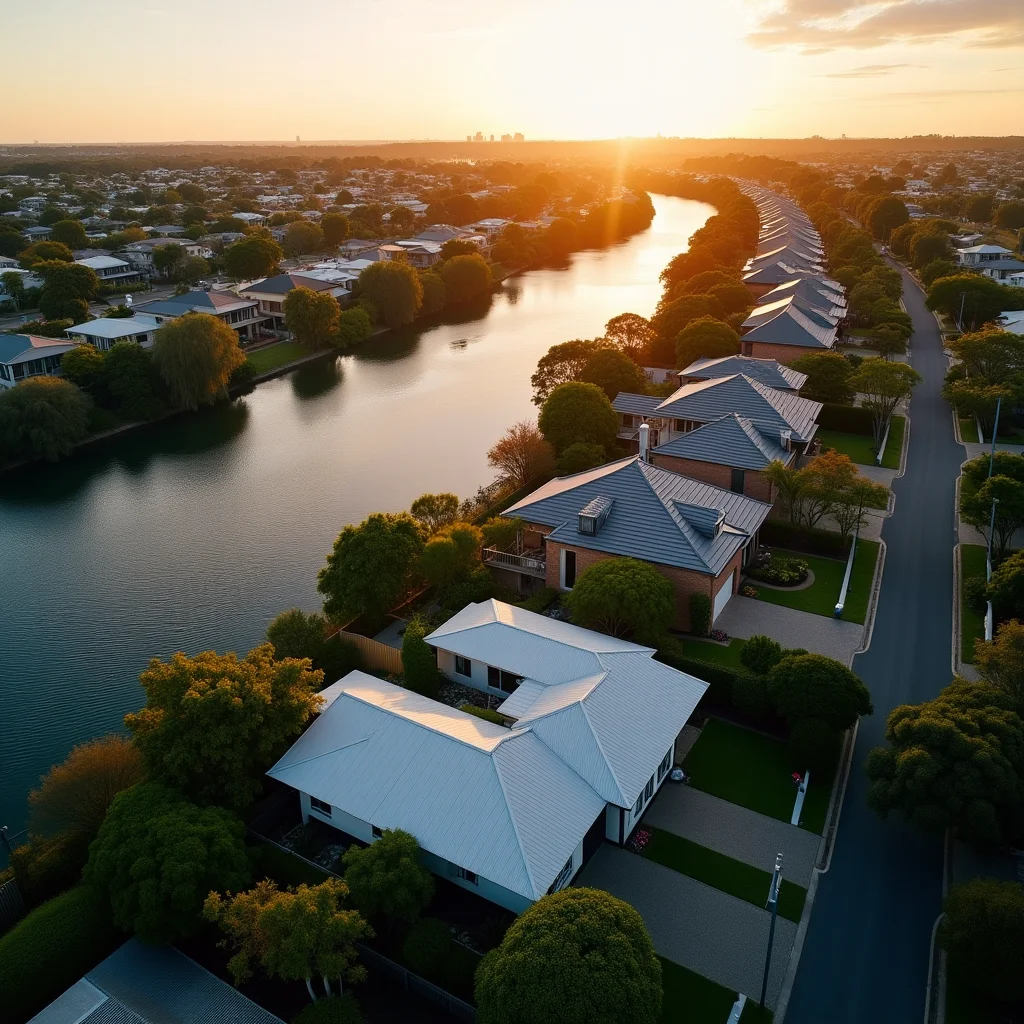
According to the Sydney Morning Herald, The property sold for $3.3 million. at an East Brisbane auction this weekend — The two families traded bids in $1,000 increments in the final stretch. to secure The source describes the home as sitting 'around the corner' from Anglican Church Grammar School; no specific distance in metres is provided.h Grammar School, known locally as Churchie. The auction result is a pointed reminder that in Brisbane's prestige market, school catchment proximity commands a premium that straightforward price-per-square-metre analysis cannot capture.
The Auction in Detail: $1,000 Bids at the Prestige End
Two Churchie families competed at the auction — both with an apparent direct interest in the Churchie connection — and the bidding war narrowed to the smallest permissible increments before a final sale price of $3.3 million was reached. The $1,000 bid increments at this price point are telling: each marginal dollar was being fought over by buyers who had already committed to a result above $3 million and were unwilling to concede. In auction theory, this behaviour signals a market where demand from a tightly defined buyer pool — families seeking proximity to a specific school — outstrips available supply of suitable properties in that micro-location.
The mechanics matter for anyone studying Brisbane's prestige market. When two highly motivated buyers converge on a single asset with a shared, non-negotiable criterion — school proximity — the auction format extracts maximum value for the vendor. Neither buyer could easily substitute the property with another listing 1.5 kilometres away without sacrificing the core attribute they were bidding for. That inelastic demand is what drives bidding down to four-figure increments at a seven-figure price point. The agent running the campaign had, in effect, marketed to the only buyers for whom this specific home was irreplaceable.
For sellers of properties near elite private schools in Brisbane — Churchie, Brisbane Grammar, Brisbane Girls Grammar, St Joseph's Nudgee — this auction reinforces a practical point: the buyer pool is narrow but deeply motivated. Campaigns targeting that pool specifically, including direct outreach to school communities, tend to outperform generic suburb-wide marketing. Vendors who understand the catchment-premium dynamic can set reserves with greater confidence than in markets driven by broader demographic demand.
Historically, school-zone premiums in Australian cities have been documented most thoroughly in Sydney and Melbourne, where suburbs abutting selective public schools trade at sustained premiums relative to adjacent areas. Brisbane's prestige tier has developed a similar dynamic around its private school corridor — from East Brisbane through Coorparoo and along the river toward St Lucia — as interstate migration has brought buyers accustomed to paying school-zone premiums in those southern markets. The $3.3 million result is consistent with that structural shift accelerating in recent years.
What This Says About Brisbane's Prestige Market in Mid-2026
The East Brisbane result does not exist in isolation. Brisbane's prestige tier has been tracking strong demand throughout 2026, underpinned by continued interstate migration from Sydney and Melbourne, a post-Olympic infrastructure narrative, and a tax environment that buyers may perceive as comparatively favourable for prestige-tier purchases. At $3.3 million, this home sits at the lower end of Brisbane's prestige bracket — accessible to buyers priced out of equivalent school-adjacent properties in Sydney's inner suburbs, where comparable proximity to a leading GPS school typically commands a substantially higher price.
At Brisbane's prestige tier, school-zone proximity has evolved from a soft preference into a hard pricing driver — with auction results like this $3.3 million East Brisbane sale demonstrating that a tightly defined buyer pool will bid to the limit of their capacity rather than accept a substitute location.
The broader Queensland market context reinforces the prestige story. REAStats analysis published in August 2026 shows that while Sydney's inner west is recording sales $300,000 below February 2026 peaks, WA and Queensland markets are drawing interstate investors seeking value relative to their southern benchmarks. That capital rotation is not confined to the sub-$1 million investor segment — it extends into the prestige tier, where cashed-up Sydney and Melbourne families are buying Brisbane homes they perceive as meaningfully underpriced against equivalent southern assets.
For investors watching Brisbane's prestige end, the East Brisbane auction offers a useful calibration point. Properties within walking distance of GPS schools — a group that includes Churchie, Brisbane Grammar, and Terrace — have demonstrated price resilience that broader suburb medians do not fully capture. An investor purchasing a character home in this corridor is buying into a demand story anchored by something more durable than sentiment: the annual intake cycle of private schools creates a recurring cohort of motivated buyers competing for limited stock each selling season.
Tax Considerations for Buyers at the $3.3 Million Mark
At a $3.3 million purchase price, the tax obligations for a Queensland buyer are material and deserve direct attention. Queensland stamp duty on a $3.3 million residential purchase represents a material cost that has a direct bearing on total acquisition cost and must be factored into any decision to bid aggressively at auction.
Capital gains tax is the other lever for buyers who are not purchasing as a primary residence. If the East Brisbane home is acquired as a family home with genuine main-residence intent, CGT will not apply on eventual sale — provided that intent is maintained throughout the ownership period. Where buyers acquire prestige properties in school-zone corridors with a view to selling once children complete schooling, the ATO's main-residence exemption rules require careful structuring. The Australian Property Tax Guide covers the full interaction between the main-residence exemption, partial exemptions, and CGT obligations in detail — essential reading before committing at this price tier. Buyers should also review the ATO's treatment of capital gains tax on Australian property if dual-use or investment intent applies.
For interstate buyers relocating from Sydney or Melbourne to secure school-adjacent property in Brisbane, the land tax position also shifts. Queensland's land tax regime applies to investment properties, but owner-occupied principal places of residence are exempt. Buyers intending to occupy the property full-time receive that exemption automatically — however, those retaining a southern investment property simultaneously should model their total land tax exposure across both states, as aggregation rules can create unexpected liability.
Practical Implications for Brisbane Buyers and Sellers in H2 2026
The East Brisbane auction delivers several actionable signals for buyers considering the Brisbane prestige corridor in the second half of 2026. First, clearance rates at the prestige end of Brisbane remain supported where vendor price expectations are aligned with genuine buyer capacity — the $3.3 million result suggests vendors who price correctly are achieving competition rather than stagnation. A home priced above genuine market value in this bracket is less likely to attract strong bidding, while one priced at market attracts the kind of two-bidder contest that produces $1,000-increment finishes.
Second, the school-zone premium is a real but non-transferable asset. A buyer paying $3.3 million for proximity to Churchie is acquiring something genuinely scarce — there are only so many properties within a short walk of any given school. That scarcity underpins resale value across market cycles in a way that broader suburb demand does not. School-adjacent prestige properties are often thought to recover more quickly from price corrections than equivalent non-catchment stock in the same suburb, though this effect is not uniform across markets.
For first-home buyers observing this market from a distance, the East Brisbane result is a useful illustration of where Brisbane's price ceiling is forming — and, by contrast, where genuine affordability still exists. The APF First Home Buyer Guide maps the full spectrum of entry-level options across Queensland for buyers who are not yet competing at the $3.3 million tier but want to understand where the growth corridors are developing relative to anchor assets like this weekend's sale.
This article was produced with AI assistance and reviewed for accuracy. Content is for informational purposes only and does not constitute financial or property investment advice.